




Fidelity Investments-

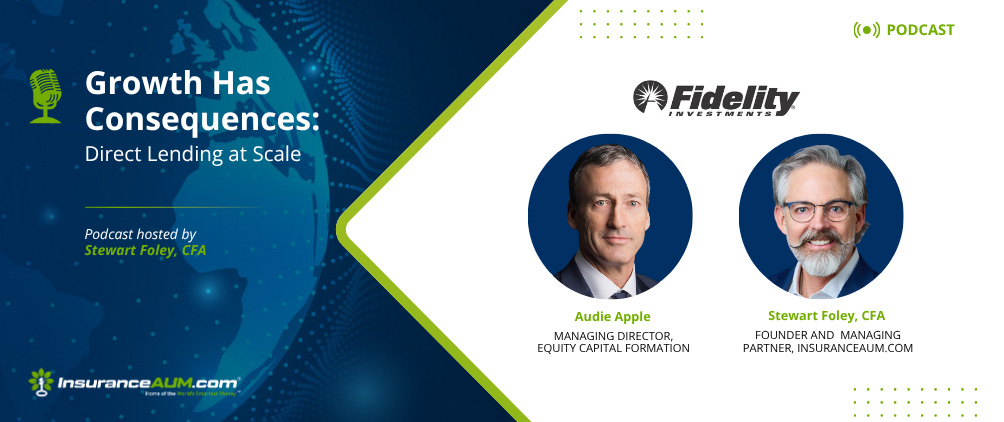
Growth Has Consequences: Direct Lending at Scale

Image
Audie Apple, Fidelity Podcast


Stewart: Hey, welcome back. It's great to have you. We've got another episode of the InsuranceAUM.com podcast. I'm your host, Stewart Foley. We've got a great one for you today. Our title is Growth Has Consequences Direct Lending at Scale. And joining me is Audie Apple, Head of Equity Capital Formation at Fidelity Direct Lending. Long-time friend, I know you're a listener. It's great to have you on Audie. Thanks for taking the time.

Audie: Thank you, Stewart. Glad to be here. Looking forward to it.

Stewart: You have held senior leadership roles across product development, sales, and private market strategies. You've also been a speaker and a writer. You've addressed capital markets and product innovation. I want to get into this. I think it's a great topic. It was your idea, and it's a good one. So, before we get going too far, though, where did you grow up? What was your first job, not the fancy one, and tell us a little bit about how you got from what is undoubtedly an illustrious start till today?

Audie: Yeah, well, sure. Listen, I was born and raised in East Texas and I think more than a sentence or two will make that pretty obvious to the listeners, but joined the asset management business 30 years ago and over that period of time have covered just about every asset class, every vehicle type, lots of jurisdictions worked globally and lived globally. So I've covered a lot of ground and really began to migrate towards private markets as I began to get exposure to that back in the mid two thousands and joined Fidelity back in 2022 to help build organically and launch our direct lending business there.

Stewart: That's super helpful. Let's just kind of jump into it. I just want to make sure I'm getting to the right point. I mean, growth and market dynamics, there's been a massive surge in direct lending, capital commitments, changing the game a little bit, I think. How has the price of capital dropped as expected with this influx of supply? Can you talk a little bit about, you've been at this a minute, it seems like there's an awful lot of money flown in here.

Audie: Well, there really has. I mean, by any perspective, it's been inspiring, you could say, but I think in full context, it's maybe even more than a lot of people realize. I mean this asset class, it took more than 20 years to reach 500 billion in assets in middle market direct lending in the US, and it's now knocking on the door of one and a half trillion dollars in the span of just about six more years. So that's a lot of incremental capital to absorb and likely to have some consequences. Now, I've seen managers' strategies, asset classes grow in the 30 years I've been in this business, and they really all have the same common denominator, the original catalyst, and it's performance. In direct lending, I think over time and more and more investors began to recognize that this asset class had a kind of interesting value proposition.

Normally, income-producing asset classes are diversifying and they do generate current income, but they're not accretive to the real return of the portfolio. They produce modest, if any real returns. Direct lending is a contractual return asset class, so you get much less dispersion around the mean. So, on a risk-adjusted basis, that looks really attractive and historically has produced real returns, returns in excess of inflation of 4% to 5%. If you think about it from that perspective, current income plus not dilutive meaningfully to the real return of the overall portfolio, that's a powerful value combination.

Stewart: Outside of financing larger deals, what other tools are being used to drive borrower demand?

Audie: Well, I would say I wouldn't just miss the larger deals very quickly because it's a lot larger deals. And if you think about that specific element first and then we'll talk about the others, is there was the first billion dollar direct loan done back in 2019 that was created a tremendous amount of fanfare, but that was on the back of just as the capital base in middle market direct lending had hit that inflection point and began growing quite significantly since that time, since that first loan of a billion dollars in 2019. The last date I've seen is that there have been over $300 billion of direct loans of a billion dollars or more originated. And that's a segment of the market that didn't really exist before, but that's defining innovation rather broadly. But there are other structural innovations that have historically made direct lending a competitive financing alternative for private equity sponsors.

In fact, you could say that much of it has kind of been designed around the needs of the private equity sponsors. So much of the opportunity has been sponsor-backed. A simple example of that is just a simple delayed draw term loan. 70%, 80% of M&A activity that's sponsor-backed is add-ons or tuck-ins: buying smaller competitors, sometimes even larger competitors, tucking them in to create inorganic growth, if you will. And so that's been one example that has long been an advantage of working with a direct lender. It's difficult to manage unfunded commitments in the syndicated loan market because the final resting place for that paper, so much of it, is in the CLO market. And so that's been an example historically of what's made the asset class quite attractive to the users of it.

Stewart: What about the tighter spreads? Well, lemme take a step back. You had mentioned sponsored deals, and just for whatever it's worth, if somebody doesn't know the difference, what's the difference between a sponsored deal and a non-sponsored deal? And let me just tack onto that. What do you think the percentage breakdown is of sponsored versus non-sponsored?

Audie: That's an interesting question. First, let's just define it. For us, a sponsored deal means they have a financial sponsor. Most people would know them as a private equity sponsor. And this is a professional counterparty. They've got a meaningful capital basis to drive growth in the business both organically and inorganically, and they’re sponsors. They're in the business of taking private companies, streamlining operations, enhancing margins, and growing the top line as well. And it's a relationship business because you've done transactions historically as a lender, you've got to do a first one of course, but typically you get to know a sponsor and you have experience working through stress episodes with their platforms and you get to know how they support and collaborate with the lenders to get 'em to the other side. And for us, a professional counterparty of that character is particularly attractive. Non-sponsored just means it's probably still a family-owned business, could be the first, second, third generation, but family-owned. And it's a little different dynamic. I think one of the major private credit consultants talks about the non-sponsored opportunity, and they assign what they call a governance premium to the non-sponsored. You might get a slight spread premium, but that governance premium is sort of their, I think, tactful way of suggesting that the C-suite executive, the management team of the operating company may or may not be as effective or they may not be as efficient or effective at navigating stress periods as a financial sponsor like a private equity sponsor may be.

Stewart: Yeah, it's interesting. I think it is also, for the most part, a sponsor deal. There's money behind it if something goes wrong. I mean, unless the PE firm goes out of business or something like that, if there's something going wrong, you can go to them and work something out, I would assume a lot easier than you can if it's family-owned. Is that a fair assessment, Audie, or am I kind of correct me where I'm wrong here?

Audie: No, I think that is a fair assessment and historically that's very much been the case. I think part of why the topic we are discussing today is of interest is because there's been such an explosion in the supply side of the equation that you naturally think that the way you adjust the supply-demand equilibrium is you change the price. Well, in direct lending, the price is more than the spread. It's spread. It's also documentation, it's capital structure leverage, and how much margin of safety is there in that capital structure. So it's a much more nuanced answer to the earlier question you're asking when you were talking about direct lending, and you're seeing movement on all those fronts. Some of that has been addressed by what we talked about earlier, doing larger and larger deals. Some of this has been addressed by extending more leverage as you do larger companies. Folks tend to buy into the idea that the larger the issuer, the safer the credit, and there's certainly some directional truth to that.

So that increases leverage levels. And then there's been innovation, and you asked about that. We didn't really completely dive into that, but more recently, we've seen things certainly post the great rate hike of 2022. Structures become more prevalent, like PIK toggle, which gives the borrower the option to PIK some of their cash coupon at origination. There's also synthetic PIK where you can use that delayed draw term loan to pay your cash coupon on the funded debt. So some of these structural elements make the asset class more attractive, and frankly, Stewart, those are risk transfers from the borrower to the lender.

Stewart: So, just help me define PIK, which stands for payment in kind. That means that I'm effectively accruing that interest to be paid later in cash. But right now, there is no cash being paid. Have I got it right?

Audie: You've got it right. Effectively, whatever is not paid in cash is added to your principal balance. So you're increasing the debt outstanding and paying only a portion of the coupon due in actual cash.

Stewart: So if I'm a borrower and I get into trouble, one thing we could do is turn the bond, make it a PIK bond, right? And you mentioned something called a PIK toggle. Is that where, as the borrower, I get to decide if it's PIK or not?

Audie: That's exactly right. PIK Toggle essentially is a structure where at initial origination you are giving the borrower the option to pay part of that in cash and part of it in kind as we just described, at origination, which is a risk transfer because if you think about it, when you get in a period of stress and the private equity sponsors always underwrite things in a straight line up to the right and it never seems to go exactly that way, of course, understandably. And when you have one that doesn't perform up to expectations, maybe they have deteriorating operating performance, the leverage goes up, and you typically would have in a direct loan financial covenants that will force that borrower back to the table to renegotiate the loan. Now we closed at four turns of leverage, and now due to deteriorating operating performance, this thing's at seven, seven and a half turns of leverage.

Now, what can we do? We're going to want to see that platform, that borrower is supported by the sponsor. The way you do that is you have a plan to execute, and likely it would include an equity infusion to de-leverage the capital structure, and in cooperation, if the sponsor's willing to support in that way, a lender will often PIK part of their interest to help support that platform. So it's a collaboration. If you incorporate the PIK toggle at the borrower's discretion at origination, you've really taken one of your most important trump cards out of your hand as a lender that gives you influence over the behavior of the sponsor and the borrower.

Stewart: If a bond goes into PIK, does that mean that the balance of the loan is increasing?

Audie: That's right.

Stewart: That's what it means. So it's actually the leverage ratios are increasing while the bond in PIK are - it's directionally right.

Audie: Think about it like this. The direct loans are generally amortized very, very small sliver, like 1% of the principal amount. So if you close on a loan and I'll just use round numbers, that a 600 spread and you closed it, 4 turns of leverage performance is deteriorated and now it's 6.5, 7 turns of leverage, you've got a different risk profile. So you're really going to want to increase the rate on that loan. It's a higher risk loan at that leverage level, but that's just going to exacerbate the stress on the borrower. So you might say to the sponsor, look, this should be priced at like 650, not 600 given the capital structure we have today, but we'll price it at 650, but we'll PIK half of it. So you'll just pay 337.50, if you will, on the cash part, and the rest will be PIKed. So that PIK element is rolled back into the principal balance outstanding.

Stewart: Yeah, that makes sense. So, are spreads structural or cyclical? Should investors today view today's tide spreads as persistent or is it cyclical?

Audie: Well, that's an interesting question because that's the question a lot of investors are trying to answer right now. And I think it sort of depends upon the part of the market that you're participating in. Look, there's always been some tangency at least and some modest overlap between the upper end of the middle market and the syndicated loan market. And so that has historically, that dynamic has been there for a long time, but with the emergence of the billion-dollar direct loan, the degree of overlap and competition there has intensified quite meaningfully. Now we understand, of course, that the syndicated loan market is effectively a cov-lite market. 90% of the outstandings cov-lite and the spreads are tighter as well. And so if you're going to take share from the syndicated loan market, which is exactly what's happened over the last five to six years, then that puts a lot of pressure for those loans that have the scale to access the syndicated loan market, which is generally a loan of $500 million or more.

And so if you're at that end of the spectrum, it appears like there could be some structural element if you're lending to companies that don't have the scale to access the syndicated loan market, there's not the competition of the syndicated loan market, you're competing with other direct lenders. But what we see there, while spreads are compressed really across the spectrum right now, it seems to be within the range, the 5% to 7% spread range that this business has been historically. But in that upper end, the very large of the upper middle market, it seems particularly aggressive, and maybe there's some structural component to where the spreads are pricing right now.

Stewart: You're giving me an excellent opportunity to do some teaching along the way here because you use the term cov-lite and for those who don't know, that essentially is short for covenant lite and covenants are some of the things that you talked about earlier, which are the terms of the loan are, is it fair to say, less stringent? Is that kind of the way to think about cov-lite? And then, when you get into the growth impact, and you've talked a little bit about this, is the greater impact of scale showing up on the risk side of the balance sheet? How have capital structures and loan docs evolved? I think you addressed this a little bit earlier, but I just want to say if there's anything that we need to cover.

Audie: So the covenants we're describing — there are always covenants in loan documents — but what we're specifically referring to when we talk about a loan as cov-lite or not is whether it has a financial or maintenance covenant that the borrower has to meet. If they trip that covenant, it forces the borrower back to the table. For most of the last 25 years, calling a direct loan cov-lite would've been considered somewhat of an oxymoron, but it's really becoming — at least on the surface — structurally a cov-lite business. And if you want to take the BSL market as a proxy, as I mentioned earlier, we think of it as structurally cov-lite today. But it was only as recently as 2014 or 2015 that the syndicated loan market crossed the 50% mark of loans being cov-lite. It hasn't always been this way.

And so over time, you get more innovative structures, borrowers become a little bit more savvy at negotiating terms, and you've got direct lenders with a lot of capital to put to work. And that combination is going to put a lot of pressure on those structures and the spreads at that end of the market. And so when you ask the question, is it structural? I think at that end the market, there may be some structural element, right? And I think one of the biggest indications of that is if you think about this as there have been research studies done by several shops on this, and that the single most statistically significant predictor of stress or defaults on a direct loan is not the size of the borrower, it's not liquidity. It is the leverage multiple, not loan to value: leverage multiple. Generally, it's a cashflow lending business, broadly speaking.

And so that is a very important metric. So a commonly referred to or tracked risk-adjusted metric is to take the spread on the direct loan divided by the turns of leverage and say, how many basis points does this spread? Am I getting for every turn of leverage in the capital structure? And if you look at the upper end of the market right now, which we'll define as loans over $100 million in EBITDA to companies with over a hundred million dollars of EBITDA. If you take the spreads based on new loan issuance in that cohort, that size cohort, it's around 80, 85 basis points per turn of leverage, which is actually right on par with the B plus, B flat segment of the syndicated loan market, which is kind of where they optimize to because that's ultimately the CLO market is the holder of that paper.

And so it actually looks very similar, could be a coincidence, could be not. At the other end of the spectrum, Stewart, the lower middle market, it's about 120 basis points of spread per turn of leverage. Now you get a little more spread in the smaller borrowers, there's not a lot, but you tend to do deals at a lot lower leverage level. So on a risk-adjusted basis, 120 versus 80, that's a 50% risk-adjusted advantage to the lower middle market. At the moment, it seems a little exaggerated, so it's a little too early to declare certainty on this, but it does look like there's some structural element taking place here.

Stewart: That's super interesting, the idea that you divide this spread by the turns of leverage to get the basis points per turn of leverage. That's an interesting metric. So what's happening to loan documentation standards? I know that cov-lite you'd mentioned is the norm, and you also mentioned a term called BSL, which is stands for broadly syndicated loans, which are the largest private loans out there, right? That's the biggest end of the market. Just for definition purposes, how should investors be thinking about defaults and recoveries? And it kind of gets me in there, seems like I've heard that there's rescue funds out there, curious to know what you think about. Is there distress in the private loan market, and let's talk a little bit about some of that business.

Audie: Yeah, I think the consequences of weakening loan documentation in the form of less prevalent financial maintenance covenants are even meaningful, because often these covenants are spoken of in binary terms like either have 'em or you don't. Of course, it's much more nuanced than that if you have a common structure is to have a total net leverage covenant if you closed at 4 turns of leverage and you might want to set a total net leverage covenant at 6.5 or maybe 7, and at that point that forces the borrower back to the table. If you don't have that structure, then you could have a total net leverage covenant. You could answer the question, yes, I do, but if you don't trip that covenant until they're at 9or 10 turns of leverage in the capital stack, that borrower's under a tremendous amount of stress already.

So you want a covenant set at a level where there's still meaningful enterprise value to motivate the sponsor to attempt to protect and preserve, right? So that covenant set too wide, this is another phrase that's used a lot. It's cov-wide. Yes, it has a covenant, but if your covenant is at or near the enterprise value multiple, how meaningful really is it? So there's a lot of nuance to this, and I think that's one of the things that investors are going to have to do more granular diligence on as they make commitments in the asset class going forward because you've got to really understand what those protections are, are they present and how strong are they, if you will.

Stewart: That is again super interesting. I appreciate, I feel like I'm getting a cook's tour here a little bit, which is really helpful. I think it's helpful to our audience as well. So when we think about the lower middle market where traditional direct lending thrives, how should allocators think about the trade-off between spread versus greater idiosyncratic risk, or said a different way, borrower-specific risk?

Audie: Well, I think the general narrative that seems to dominate thinking is that, again, as I referenced earlier, a larger borrower is a safer credit risk. If you didn't know anything else and you said, Hey, here's borrower A, they're $200 million of EBITDA, and here's borrower B, and it's 20 million of EBITDA. I mean all of the things being equal, we're going to be leaning like anyone pretty heavily to the $200 million EBITDA borrower. But then if you tell me the $200 million EBITDA borrower wants to put seven terms of leverage in the capital structure and it's cov-lite don't have anything to force 'em back to the table until they miss a payment, which is kind of after the damage has been done, but the $20 million borrower, I'm going to do four turns of leverage and have a six and a half total net leverage covenant. Well, that's a very different risk proposition.

And I think there was a very interesting study that Lincoln Financial did, which is, I think, the largest provider of valuations to direct lenders in the market. They did a very interesting study where they took their senior direct lending index, which I think has a little over 5,000 direct loans in it, and did a study back from 2014 through the middle of 2024, so about a 10-year period. And the question folks are always asking, well, what are defaults and recoveries? And the tricky thing about private markets is that private markets data is private, it's elusive, methodologies differ, and it's very difficult. You get different definitions for how they treat this. But the interesting thing about the Lincoln study is it's the actual economic outcome. So this is after defaults, after recoveries, and it splits their senior loan index by size. And so the polar ends, there were three size cohorts.

The smallest was less than 30 million of EBITDA, the largest was over a hundred. And when you looked at the net of loss, so this is after defaults after recoveries, the net of loss return over that 10-year period, if you looked at rolling one-year observations in the lower middle market, was 8.2%, Stewart. In the upper middle market, which was a hundred million or more of EBITDA. At origination, it was 7.6%. So that's a 60 basis point advantage after the presence of more idiosyncratic risk. But the fact is that that risk is largely mitigated by having less leverage in the capital structure, that is the most effective risk mitigator. Now we've talked about these covenants being meaningful as well. Those also contributed. They're contributing less so now and going forward as the upper middle market has become so structurally cov-lite. But if you think about it, in the 10 years of this study, most of those loans in all size cohorts had financial covenants.

I think the question investors want to ask themselves now is looking forward, is that going to have an impact? And then one more thing, oh, by the way, volatility is often not much of a guide for obvious reasons in private markets for a risk metric, but dispersion around the mean certainly can be. And if you looked at that Lincoln study, when you looked at rolling one year net of loss returns, the dispersion around that 8.2% median observation was a little over 800 basis points in the lower middle market, the same metric, the dispersion in the over $100 million borrower segment was a little over 1100 basis points. So you had a 60 basis point net of loss return premium in the lower middle market and tighter dispersion around the median observation. Pretty compelling.

Stewart: That is compelling. Okay, last question before we wrap. Can you talk about one thing that you consistently see in institutional investors overlook when they're evaluating a direct lending platform?

Audie: Well, I would say one of the old sayings in the business is you can't buy a track record. And a track record is I think about a track record as like an archeological dig. If you've ever been on archeological dig, you've got these sediment layers and when you take samples from a given sediment layer, what you get in that layer is a representation of what the performance was, what the character of the portfolio was at the time that that portfolio was originated and ultimately realized. And it's changed over time, and I think in the last five to six years, with this explosive growth in capital, there have been material structural changes. And so I think the diligence effort at this point for investors is to look beyond the track record per se, superficially, but understand what the composition was—covenants, leverage levels, borrower sizes, et cetera.

And to what extent is the opportunity set that that lender is focused on exploiting today? To what extent does it look different than what has produced the track record historically? I mean, folks are always concerned about the ability to navigate stress. They like lenders that have been through periods of stress together. But you have to ask yourself this question when you think about that specific thing, and that is the toolkit that the lender has to navigate. Those stress periods the same today as it was historically to the extent that their loan book today is materially cov-lite as toggle, et cetera. It's a different fact pattern. And I think that's really what the diligence efforts have to be focused on at the moment.

Stewart: Does it matter how long the team itself has been there? Does it matter that the people who I guess is the talent with the systems that the firm has, or how much of it is the people that are running those analytics? Does it matter how long the team's been there, I guess, is my question?

Audie: They both matter, Stewart. They both matter. You've got to have experience, you've got to have lenders that have been through periods of stress, and the firm's got to be structurally important to the borrower as well. Like you want to have scale, you want to matter if you've got to be more than money to the sponsor and their borrowers. So they both really matter. You've got to have the experience individually, resident and the direct lending team, broader firm resources can support that as well. I mean, it's great if they happen to have worked through stress together, but sometimes the best outcome comes from multiple orthogonal inputs from different experiences on different platforms. So I think it all really matters. I think perhaps the most important thing, I'll go back to where I started is the toolkit you're working with to navigate the next stress period as robust and comprehensive as it was in the past. And to the extent that it is great, but I think for the upper end of the market, that question is outstanding and I'm not sure it's really fully understood at the moment.

Stewart: What are a couple of key takeaways from today? If our Audience was just two things they wanted to know about this today, what would they be?

Audie: I think it's just understanding that historically, direct lending was viewed monolithically as an asset class. And the only question you really get was what's the median and average EBITDA of the borrowers in your portfolio? And it was just left at that. Well, now there's been a bifurcation of the opportunity set. Okay, there's that large market that is competing day in, day out with the syndicated loan market like sponsors, just to give you an idea and bring to life more how intense that is. I mean, a sponsor will often run a parallel process investigating a syndicated loan issuance with a banker, talk to some large direct lenders as well. And depending on timing and pricing and structure will make the choice accordingly. That's going to hold your feet to the fire and puts a lot of pressure on that end of the market. So that market looks very different.

One of my friends in the business refers to that as the DSL market. It's the directly syndicated loan as opposed to the broadly syndicated loan. Whether that's fully true or not will be determined in the future, but it was certainly something for some comic relief when he mentioned it to me. And so traditional direct lending is a structure that is time-tested. It's been around for decades, and by traditional direct lending, that means a loan with a margin of safety in the capital structure and a meaningful financial covenant that, when tripped, forces the borrower back to the table. I think investors are too focused on does the team have together experience working through these stress periods with their book? The question they should be asking is, do they have the toolkit today that historically allowed them to navigate those stress periods? And to the extent they don't, what's going to give me confidence that I'm going to get a similar outcome as you go down market in the lower end of the market where you're more insulated from what's going on in the syndicated loan market, you're getting traditional structures and you're getting meaningful covenants.

And as long as you're thoughtful about diversification, idiosyncratic risk is diversifiable risk in properly constructed, Stewart. At the end of the day, you're left with a fully diversified portfolio, you're left with a loan book with higher spreads, lower leverage, and meaningful financial covenants. And that on a risk-adjusted basis makes a lot of sense to us.

Stewart: Makes sense. So I really appreciate the education. It's been really helpful to me, and I've gotten some really good takeaways. One of the questions we've been asking of late is, when you're adding to your team, what are the characteristics that you're looking for in folks that you interview?

Audie: There was a quote I remember that was attributed to General Patton, I assume it was. He said, supposedly, if everybody's thinking alike, then somebody isn't thinking; you've got to be on the lookout in every conceivable direction for what could go wrong as a credit lender. I mean, if you want to feel good, talk to your venture capital investors, your buyout investors, the equity people, and you'll feel real good. If you're feeling a little too good and you want to get a balanced perspective, talk to your credit investors. They're going to be very negative, right? But I mean, you just have to look for things that are going to go wrong, and you have to have the ability and the confidence to think independently, approach challenges from an orthogonal perspective, something different, but also have the humility and sense of collaboration. Understand you may or may not be right. I mean one way you could say it is you're looking for people that have the ability and confidence to disagree without being disagreeable.

Stewart: Yeah, I like that. Alright, so fun one for you, one dinner for four, it's you and up to three guests. Who would you most like to have dinner with, alive or dead, Audie Apple?

Audie: Well, right now I've got an answer to that question in the spirit of the topic that we covered today. My answer is Abraham Lincoln and Salmon Chase. Now, Salmon Chase may not be as recognizable a name as Abraham Lincoln, but there’s a great book that I was reading was actually listening to an audiobook on one of my trips overseas earlier this year, called Ways and Means, by Lowenstein. And Chase was the Secretary of the Treasury for Lincoln. Before Lincoln took office, the states started seceding, and he had to fight a civil war. The only source of income our country had at that time was tariffs, ironically, and a war was probably not going to be good for cross-border trade. So we had to finance a war. We didn't have a currency. We didn't have the ability to issue debt. We didn't have any income tax of any type, and we had to figure it out. And that's the story of how Lincoln and Salmon Chase, and the other leadership in that administration financed the Civil War. So really there were two battles going on. There was the battlefield battle and then there was the economic battle that was being fought between the north and the South, and it was a fascinating read.

Stewart: That's really cool. Thanks for being on. I really appreciate it. We've been friends for a long time. I think you're a very talented person in this space, and very happy to have you on. And thanks for the idea. I thought it was really, really a good idea, and particularly right now, where we are with private lending and private assets. Good deal, man. Thanks for taking the time.

Audie: Hey, enjoyed it, Stewart. Anytime.

Stewart: Thanks for listening. The title of the podcast has been Growth Has Consequences, Direct Lending at Scale, and we've been joined today by Audie Apple, head of Equity Capital Formation with Fidelity Direct Lending. Please rate us, like us, and review us on Apple Podcast, Spotify, or our brand new YouTube channel listed under InsuranceAUM community. We'll see you again next time in the home of the world's smartest Money at InsuranceAUM.com.


Information provided in the program is for informational, educational purposes only. To the extent any investment information is deemed to be a recommendation, it is not meant to be impartial investment advice, or advice in a fiduciary capacity, and is not intended to be used as a primary basis for you or your clients’ investment decisions. 
Fidelity and its representatives may have a conflict of interest in the products or services mentioned in this material, because they have a financial interest in them and receive compensation directly or indirectly in connection with the management, distribution, and/or servicing of these products or services, including Fidelity funds, certain third-party funds and products, and certain investment services. 
Views expressed are as of the day of the recording, based on the information available at that time, and may be changed based on market or other conditions. Unless otherwise noted, the opinions provided are those of the speakers, and not necessarily those of Fidelity Investments or its affiliates. 
Alternative investments are investment products other than the traditional investments of stocks, bond, mutual funds, or ETFs. Examples of alternative investments are limited partnerships, limited liability companies, hedge funds, private equity, private debt, commodities, real estate, and promissory notes. Some of the risks associated with alternative investments are: Alternative investments maybe relatively illiquid. It may be difficult to determine the current market value of the asset. There may be limited historical risk and return data. A high degree of investment analysis maybe required before buying. Costs of purchase and sale may be relatively high.
Fidelity does not assume any duty to update any of the information. Fidelity Investments is a client of Insurance AUM, and is an independent company, unaffiliated with Fidelity Investments. Its business models, needs, and results may not reflect the experience of other Fidelity clients. 
Third-party trademarks and service marks are the property of their respective owners. All other trademarks and service marks are the property of FMR LLC or its affiliates. All other trademarks and service marks are the property of FMR LLC, or its affiliated companies. 
Fidelity Investments provides investment products through Fidelity Distributors Company LLC; clearing, custody, or other brokerage services through National Financial Services LLC or Fidelity Brokerage Services LLC, members NYSE, SIPC; and institutional advisory services through Fidelity Institutional Wealth Advisor LLC, copyright 2024 FMR LLC, all rights reserved, 
1212103.1.0

Share this post

Sign Up Now for Full Access to Articles and Podcasts!

Unlock full access to our vast content library by registering as an institutional investor

Register

Contacts


Fidelity Investments

Fidelity Institutional offers investment insights, strategies, and solutions as well as trading and prime brokerage services, to a wide range of wealth management firms, asset managers, and institutional investors. Fidelity’s mission is to strengthen the financial well-being of our customers and deliver better outcomes for the clients and businesses we serve. With an AUA of $15.1 trillion, including discretionary assets of $5.9 trillion as of December 31, 2024, we focus on meeting the unique needs of a diverse set of customers. Privately held nearly 80 years, Fidelity employs 77,000+ associates who are focused on the long-term success of our customers.

William Johnson     
Head of Institutional Large Market Sales     
William.R.Johnson@fmr.com     
773-454-4100

900 Salem Street 
Smithfield, RI 02917

 

View the contributor page

Sign Up Now for Full Access to Articles and Podcasts!

Unlock full access to our vast content library by registering as an institutional investor .

Create an account

Already have an account ? Sign in

Ѐ Ё Ђ Ѓ Є Ѕ І Ї Ј Љ Њ Ћ Ќ Ѝ Ў Џ А Б В Г Д Е Ж З И Й К Л М Н О П Р С ΄ ΅ Ά · Έ Ή Ί Ό Ύ Ώ ΐ Α Β Γ Δ Ε Ζ Η Θ Ι Κ Λ Μ Ν Ξ Ο Π Ρ Ё Ђ Ѓ Є Ѕ І Ї Ј Љ Њ Ћ Ќ Ў Џ А Б В Г Д Е Ж З И Й К Л М Н О П Р С Т У Ф Х Ц Ч Ш Ā ā Ă ă Ą ą Ć ć Ĉ ĉ Ċ ċ Č č Ď ď Đ đ Ē ē Ĕ ĕ Ė fi fl œ æ ß